
Introduction: Why Every Growing Business Needs More Than Just a Website
The way businesses operate in Pakistan is changing rapidly. From small retail shops and emerging startups to established companies and online brands, more businesses are recognising the importance of having a strong digital presence. Customers increasingly research products, compare services, check company profiles, and contact businesses online before making purchasing decisions. In this environment, a professional website is no longer just an optional marketing tool. It is an important part of how a company presents itself, communicates with customers, and creates new business opportunities.
However, simply launching a website does not guarantee more enquiries or sales. Many businesses invest in attractive designs but overlook important elements such as website speed, mobile usability, search engine optimisation, customer journeys, and conversion-focused features. A successful business website needs to do much more than look impressive. It should help visitors understand what the company offers, build confidence in its services, and make it easy for potential customers to take action.
In 2026, businesses in Pakistan need websites that combine professional design, reliable development, useful functionality, and a clear digital marketing strategy. Understanding how these elements work together can help companies build an online platform that supports both their current requirements and future growth.
Step 1: Define What You Want Your Website to Achieve
Before choosing colours, layouts, or development platforms, it is important to understand what your business actually needs from its website. Different companies have different objectives, and the website structure should reflect those priorities. A professional services company may want visitors to request consultations, while a retail business may need an online store where customers can browse products and place orders. A growing organisation might require a more advanced platform to manage internal operations, customer information, and business processes.
Defining these objectives at the beginning helps prevent unnecessary development costs and reduces the risk of building features that do not contribute to business performance. Businesses should consider their target audience, the services or products they offer, the information customers need before making decisions, and the actions they want visitors to take. When these requirements are clear, designers and developers can create a website that serves a genuine business purpose rather than simply following a visual trend.
Step 2: Invest in Professional Website Design and User Experience
First impressions matter in the digital world. When visitors arrive at a website, they quickly form an opinion about the business based on its appearance, organisation, and ease of use. An outdated layout, confusing navigation, inconsistent colours, or difficult-to-read content can reduce confidence before a potential customer even explores the company’s services.
Professional website design should reflect the identity of the business while making information easy to understand. A clear homepage, well-organised service sections, readable typography, relevant imagery, and visible contact options help visitors navigate the website without unnecessary effort. Every important page should communicate its purpose and guide users towards a relevant next step.
Modern UI/UX design also focuses on how people interact with different website elements. Buttons should be easy to identify, menus should be straightforward, and forms should request only the information that is genuinely needed. Rather than filling every page with decorative features, businesses should prioritise layouts that support usability, accessibility, and customer engagement.
Step 3: Make Your Website Mobile-Friendly and Fast
Mobile usability is especially important for businesses targeting customers in Pakistan. Many people browse websites through smartphones, often using mobile data and varying internet connections. If a website takes too long to load, displays incorrectly, or requires excessive scrolling, visitors may leave before finding the information they need.
Responsive web design ensures that a website adjusts properly to different screen sizes, including smartphones, tablets, laptops, and desktop computers. However, responsiveness alone is not enough. Developers also need to consider image optimisation, efficient coding, browser compatibility, and overall website performance.
Fast-loading pages improve the browsing experience and help visitors reach important information without frustration. Technical performance can also influence search visibility, making website speed and mobile usability important considerations during development. Businesses should test their websites on real devices before launch rather than assuming that everything will work correctly simply because the desktop version looks good.
Step 4: Choose the Right Web Development and Technology Solutions
Behind every effective website is a reliable technical structure. Website development involves the functionality that allows visitors to interact with pages, submit enquiries, browse products, access accounts, and use other digital features. Choosing the right technology depends on the complexity of the business and the type of experience it wants to provide.
A straightforward company website may only require essential service pages, a contact form, and an easy-to-manage content system. An e-commerce business, however, needs additional capabilities such as product catalogues, shopping carts, secure payment integration, order management, and inventory features. Larger organisations may require custom web applications that connect different departments and automate specific business processes.
Professional web development should also consider website security, database management, scalability, maintenance, and future upgrades. Businesses should avoid selecting technology purely because it is popular or inexpensive. The right solution is one that meets actual requirements, performs reliably, and can accommodate future changes without requiring a complete rebuild.
Step 5: Turn Your Website into an Online Store with E-commerce Solutions
For businesses selling products, an e-commerce website can create opportunities beyond traditional physical sales. Customers can explore product collections, review specifications, compare options, and place orders without visiting a shop in person. This is particularly useful for Pakistani brands looking to reach customers in different cities and expand beyond their immediate geographical markets.
A successful online store requires more than uploading product photographs and displaying prices. Product descriptions should provide accurate information, categories should be easy to navigate, and the checkout process should be simple. Payment options, delivery information, return policies, and customer support details should also be clearly presented.
E-commerce development should be planned around the customer’s purchasing journey. If visitors find it difficult to locate products or complete checkout, they may abandon their orders. A well-structured online store combines attractive product presentation with reliable functionality, helping businesses create a more convenient shopping experience and manage their digital sales operations efficiently.
Step 6: Use ERP and CRM Systems to Improve Business Operations
As a business expands, managing customer information, sales records, inventory, employee responsibilities, and daily operations through separate tools can become increasingly difficult. This is where ERP and CRM solutions can make a meaningful difference.
Enterprise Resource Planning (ERP) systems help businesses organise and manage important operational activities through integrated software. Depending on the organisation’s requirements, this may include inventory management, financial processes, purchasing, reporting, and other internal workflows. Customer Relationship Management (CRM) systems, on the other hand, help businesses organise customer information, track enquiries, manage sales opportunities, and maintain communication throughout the customer journey.
Integrating suitable ERP and CRM solutions can reduce repetitive administrative work and improve access to business information. Instead of relying on disconnected spreadsheets and manual processes, organisations can use centralised systems that support better coordination and decision-making. Custom software development can further extend these capabilities when a company has specific operational requirements that standard platforms cannot fully address.
Step 7: Build a Mobile App to Keep Your Customers Connected
Mobile applications can offer additional opportunities for businesses that want to create stronger digital relationships with their customers. While a responsive website is often sufficient for many businesses, an app can provide a more dedicated experience for customers who regularly interact with a brand or use its services.
Depending on the business model, a mobile application may include customer accounts, product browsing, online bookings, order tracking, notifications, payment features, or service management tools. Retail businesses, delivery services, educational platforms, and organisations with recurring customer interactions may benefit from app-based functionality.
The decision to develop a mobile application should be based on actual customer needs rather than the assumption that every company requires one. A well-planned application should solve a specific problem, offer a convenient experience, and provide value that justifies the additional development and maintenance investment.
Step 8: Make SEO and Digital Marketing Part of Your Website Strategy
A professionally designed website is valuable only when potential customers can discover it. Search engine optimisation helps improve the visibility of website pages for relevant search queries, while digital marketing supports broader audience reach and lead generation.
SEO should be considered during the website development process rather than added as an afterthought. Proper heading structures, descriptive page titles, relevant keywords, clean URLs, mobile responsiveness, fast loading speeds, and useful website content all contribute to a stronger technical and content foundation.
For businesses in Pakistan, keyword targeting should reflect how local customers search for products and services. A company operating in Karachi, for example, may need content that addresses relevant service searches in its target market, while a business selling nationally may require a broader content strategy. Google Ads and other paid marketing campaigns can complement organic SEO company by helping businesses reach relevant audiences through targeted advertising.
The most effective approach combines a search-friendly website with useful content, well-planned campaigns, and clear conversion goals. Traffic alone is not the ultimate objective. Businesses should focus on attracting relevant visitors who are more likely to enquire, purchase, or become long-term customers.
Step 9: Use Creative Visual Content to Make Your Brand Memorable
Visual communication plays an important role in how customers understand and remember a business. Professional graphics, product imagery, promotional videos, and motion graphics can make complex information easier to understand while strengthening brand identity.
Motion graphics are particularly useful for explaining services, introducing products, presenting business processes, and communicating important messages in a visually engaging format. They can also support social media campaigns, website landing pages, and digital advertising.
However, creative elements should complement the website rather than make it unnecessarily complicated. Heavy animations and oversized media files can slow down pages, particularly for mobile users. A balanced visual strategy uses high-quality creative assets while maintaining performance, readability, and a consistent brand identity.
Why Choose Website Designs PK for Your Digital Growth?
Building an effective digital presence requires different areas of expertise, from visual design and technical development to e-commerce functionality, business software, and digital marketing. Managing these requirements through multiple disconnected providers can make communication and project coordination more complicated.
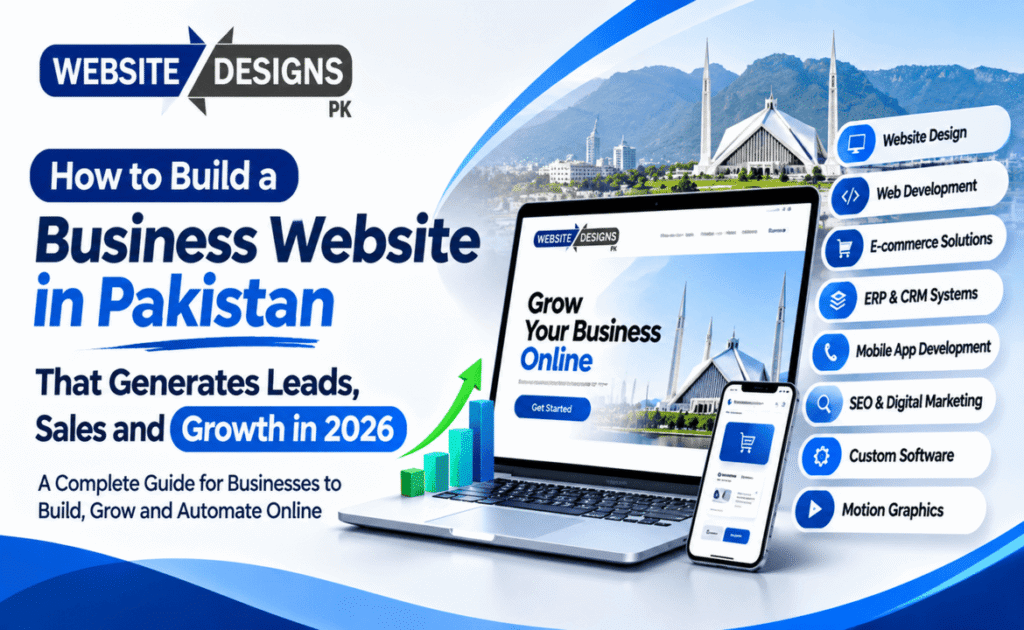
Website Designs PK offers a range of digital solutions for businesses in Pakistan, including professional website design, web development, e-commerce solutions, ERP and CRM systems, mobile application development, SEO, digital marketing, and custom software. Its approach focuses on combining creative design with practical functionality, responsive development, and technology solutions that support business requirements.
The company also highlights its experience in delivering digital projects and its structured development process, which includes discovery, planning, UI/UX design, development, quality assurance, and launch. This type of organised workflow helps businesses understand how their ideas can move from initial planning to a working digital product.
Whether you are launching a new business website, upgrading an existing platform, developing an online store, or exploring custom software, choosing a suitable digital partner can help you make better technology decisions and build a stronger online foundation.
Conclusion: Build a Digital Platform That Grows With Your Business
A successful business website should do more than introduce a company to the online world. It should support customer communication, generate relevant enquiries, simplify purchasing decisions, and provide the technical foundation needed for future expansion. In Pakistan’s increasingly competitive digital market, businesses need to consider website design, development, e-commerce, automation, mobile applications, and digital marketing as connected parts of their overall growth strategy.
The best approach is to start with clear business objectives, understand customer expectations, and invest in technology that solves real problems. A fast, mobile-friendly website with useful content and reliable functionality can become a valuable business asset rather than just another online expense.
If you are ready to strengthen your digital presence, launch an online store, or develop a customised business solution, explore the services offered by Website Designs PK at https://websitedesigns.com.pk/. Discover how professional website design, development, and integrated digital solutions can help your business build a stronger online presence and prepare for its next stage of growth.